Thomas Wimmer
PhD Student at the Max Planck ETH Center for Learning Systems (CLS).
I am a doctoral student at the Max Planck ETH Center for Learning Systems (CLS) and ELLIS programs. My advisors are Jan Eric Lenssen, Bernt Schiele (MPI), and Siyu Tang (ETH).
I previously graduated from master's degrees at the Technical University of Munich and the Institut Polytechnique de Paris. During my studies, I collaborated and worked in the groups of Daniel Cremers, Maks Ovsjanikov, Peter Wonka, and Federico Tombari.
My main research interests are visual representation learning and 3D computer vision. However, I am always open to new ideas and collaborations in related fields. This website gives you an overview of my recent research and other projects.
I am currently spending time at Google Zurich as a Student Researcher.







News
-
May 2026
Excited to give a talk at the BLISS Speaker Series on June 16, 2026 at 7PM. My talk will be titled "Beyond Patches: Learning Dense Visual Features". Slides are available here.
-
May 2026
Happy to share that I will start a new position as Student Researcher at Google in Zurich in June 2026.
-
Oct 2025
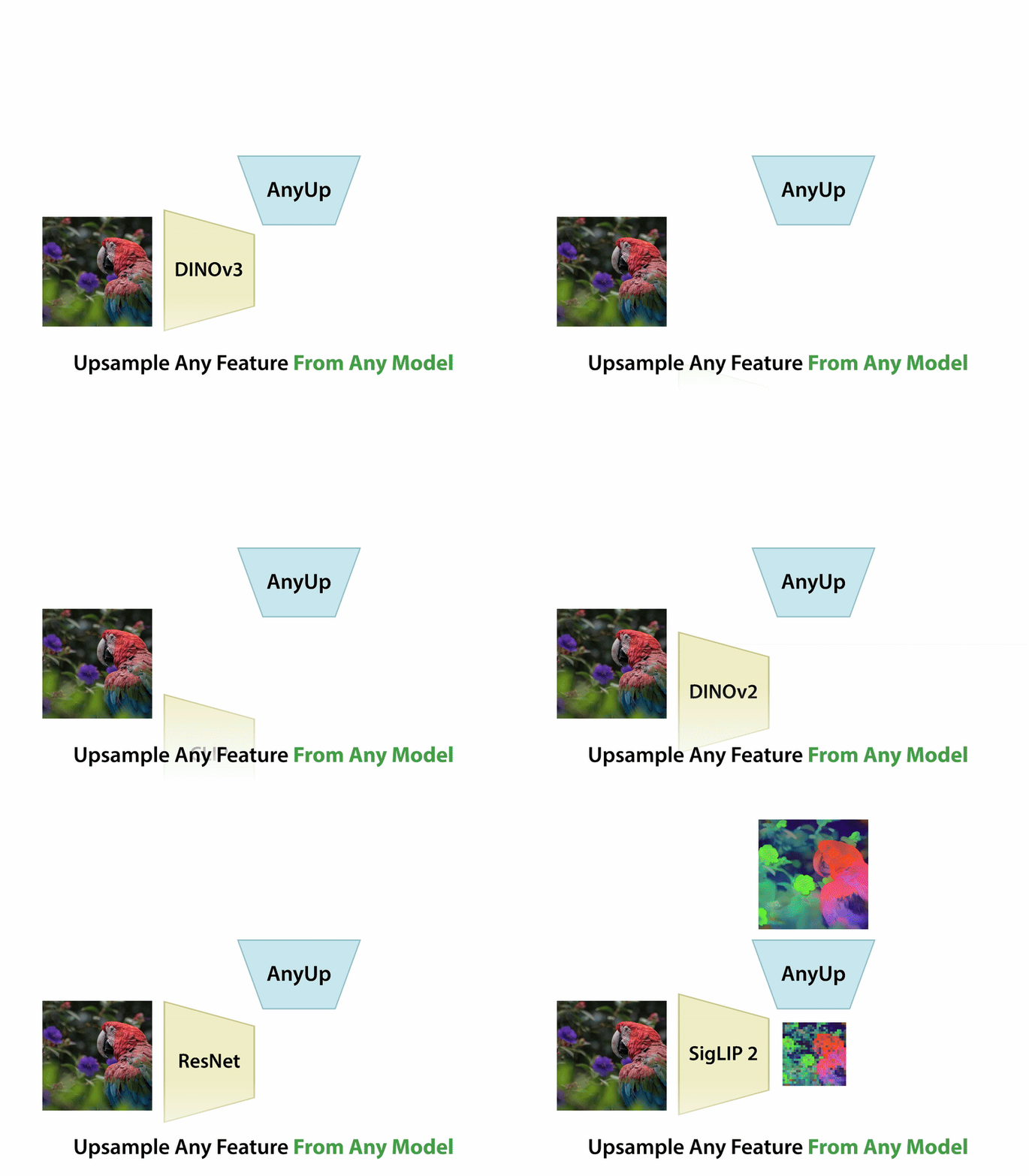
New pre-print: "AnyUp: Universal Feature Upsampling" is now available on arXiv! Super excited to share this work, where we propose a first-of-its-kind feature-agnostic upsampling architecture that can upsample features from any vision model at any resolution, without requiring any encoder-specific training. New state-of-the-art results on multiple downstream benchmarks, while being the first upsampler that naturally generalizes to different feature types at inference time. Accepted to ICLR 2026 as an oral presentation!
-
Jun 2025
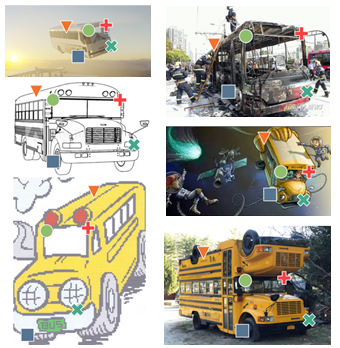
New pre-print: "Do It Yourself: Learning Semantic Correspondence from Pseudo-Labels" is now available on arXiv! We show that foundational features can be refined with an adapter that is trained with pseudo-labels, which are themselves zero-shot predictions using the same foundational features. We improve the quality of pseudo-labels through 3D-aware chaining with cycle-consistency and reject wrong pairs using a spherical prototype. New state-of-the-art results on SPair71k and scalable to larger datasets. Accepted to ICCV 2025!
-
Jan 2025
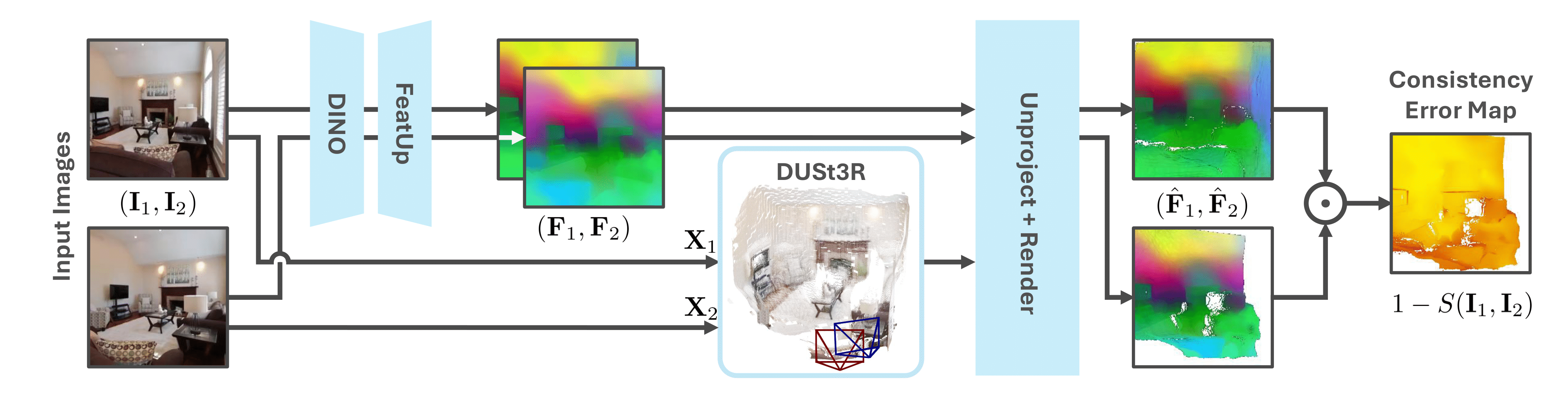
Our pre-print "MEt3R: Measuring Multi-View Consistency in Generated Images" is now available on arXiv! In this work, we propose a DUSt3R-based method to measure multi-view consistency which can, e.g., be used to evaluate the 3D consistency of video diffusion models. Accepted to CVPR 2025!
Publications
-
 ICLR 2026 Oral
AnyUp: Universal Feature Upsampling
We introduce AnyUp, a method for feature upsampling that can be applied to any vision feature at any resolution, without encoder-specific training. Existing learning-based upsamplers for features like DINO or CLIP need to be re-trained for every feature extractor and thus do not generalize to different feature types at inference time. In this work, we propose an inference-time feature-agnostic upsampling architecture to alleviate this limitation and improve upsampling quality. In our experiments, AnyUp sets a new state of the art for upsampled features, generalizes to different feature types, and preserves feature semantics while being efficient and easy to apply to a wide range of downstream tasks.
BibTeX@inproceedings{wimmer2026anyup, title = {AnyUp: Universal Feature Upsampling}, author = {Wimmer, Thomas and Truong, Prune and Rakotosaona, Marie-Julie and Oechsle, Michael and Tombari, Federico and Schiele, Bernt and Lenssen, Jan Eric}, booktitle = {Proceedings of the International Conference on Learning Representations ({ICLR})}, year = {2026}, } -
 ICCV 2025
Do It Yourself: Learning Semantic Correspondence from Pseudo-Labels
Finding correspondences between semantically similar points across images and object instances is one of the everlasting challenges in computer vision. While large pre-trained vision models have recently been demonstrated as effective priors for semantic matching, they still suffer from ambiguities for symmetric objects or repeated object parts. We propose to improve semantic correspondence estimation via 3D-aware pseudo-labeling. Specifically, we train an adapter to refine off-the-shelf features with pseudo-labels obtained via 3D-aware chaining, filtering wrong labels through relaxed cyclic consistency, and 3D spherical prototype mapping constraints. While reducing the need for dataset specific annotations compared to prior work, we set a new state-of-the-art on SPair-71k by over 4% absolute gain and by over 7% against methods with similar supervision requirements. The generality of our proposed approach simplifies extension of training to other data sources, which we demonstrate in our experiments.
BibTeX@inproceedings{duenkel2025diysc, title = {Do It Yourself: Learning Semantic Correspondence from Pseudo-Labels}, author = {Dünkel, Olaf and Wimmer, Thomas and Theobalt, Christian and Rupprecht, Christian and Kortylewski, Adam}, booktitle = {Proceedings of the IEEE/CVF International Conference on Computer Vision ({ICCV})}, year = {2025}, } -
 CVPR 2025
MEt3R: Measuring Multi-View Consistency in Generated Images
We introduce MEt3R, a metric for multi-view consistency in generated images. Large-scale generative models for multi-view image generation are rapidly advancing the field of 3D inference from sparse observations. However, due to the nature of generative modeling, traditional reconstruction metrics are not suitable to measure the quality of generated outputs and metrics that are independent of the sampling procedure are desperately needed. In this work, we specifically address the aspect of consistency between generated multi-view images, which can be evaluated independently of the specific scene. Our approach uses DUSt3R to obtain dense 3D reconstructions from image pairs in a feed-forward manner, which are used to warp image contents from one view into the other. Then, feature maps of these images are compared to obtain a similarity score that is invariant to view-dependent effects. Using MEt3R, we evaluate the consistency of a large set of previous methods for novel view and video generation, including our open, multi-view latent diffusion model.
BibTeX@inproceedings{asim25met3r, title = {MEt3R: Measuring Multi-View Consistency in Generated Images}, author = {Asim, Mohammad and Wewer, Christopher and Wimmer, Thomas and Schiele, Bernt and Lenssen, Jan Eric}, booktitle = {Proceedings of the IEEE/CVF Conference on Computer Vision and Pattern Recognition ({CVPR})}, year = {2025}, } -
 3DV 2025
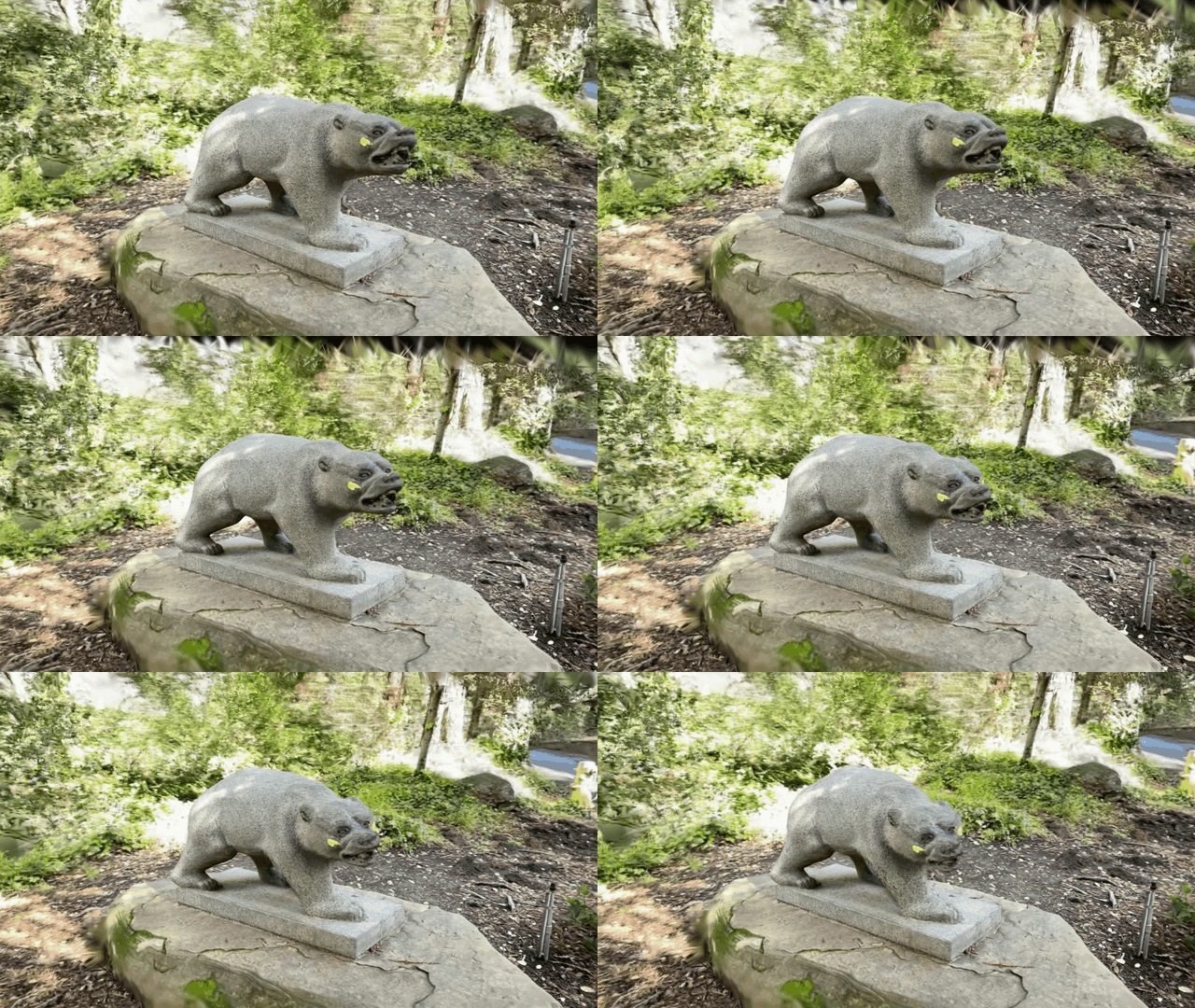
Gaussians-to-Life: Text-Driven Animation of 3D Gaussian Splatting Scenes
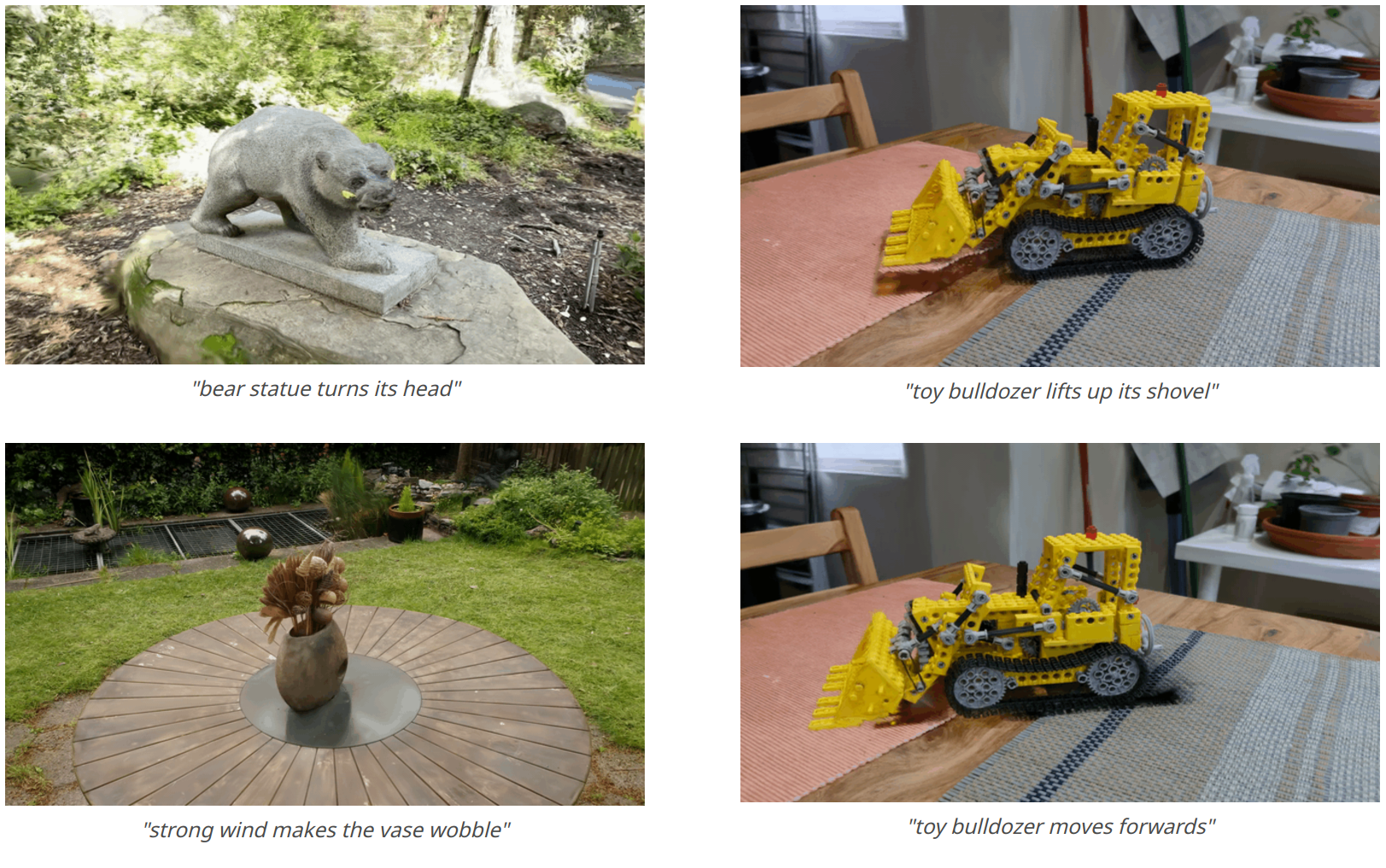
State-of-the-art novel view synthesis methods achieve impressive results for multi-view captures of static 3D scenes. However, the reconstructed scenes still lack “liveliness,” a key component for creating engaging 3D experiences. Recently, novel video diffusion models generate realistic videos with complex motion and enable animations of 2D images, however they cannot naively be used to animate 3D scenes as they lack multi-view consistency. To breathe life into the static world, we propose, a method for animating parts of high-quality 3D scenes in a Gaussian Splatting representation. Our key idea is to leverage powerful video diffusion models as the generative component of our model and to combine these with a robust technique to lift 2D videos into meaningful 3D motion. We find that, in contrast to prior work, this enables realistic animations of complex, pre-existing 3D scenes and further enables the animation of a large variety of object classes, while related work is mostly focused on prior-based character animation, or single 3D objects. Our model enables the creation of consistent, immersive 3D experiences for arbitrary scenes.
BibTeX@inproceedings{wimmer2025gaussianstolife, title = {Gaussians-to-Life: Text-Driven Animation of 3D Gaussian Splatting Scenes}, author = {Wimmer, Thomas and Oechsle, Michael and Niemeyer, Michael and Tombari, Federico}, booktitle = {2025 International Conference on 3D Vision (3DV)}, year = {2025}, } -
 CVPR 2024
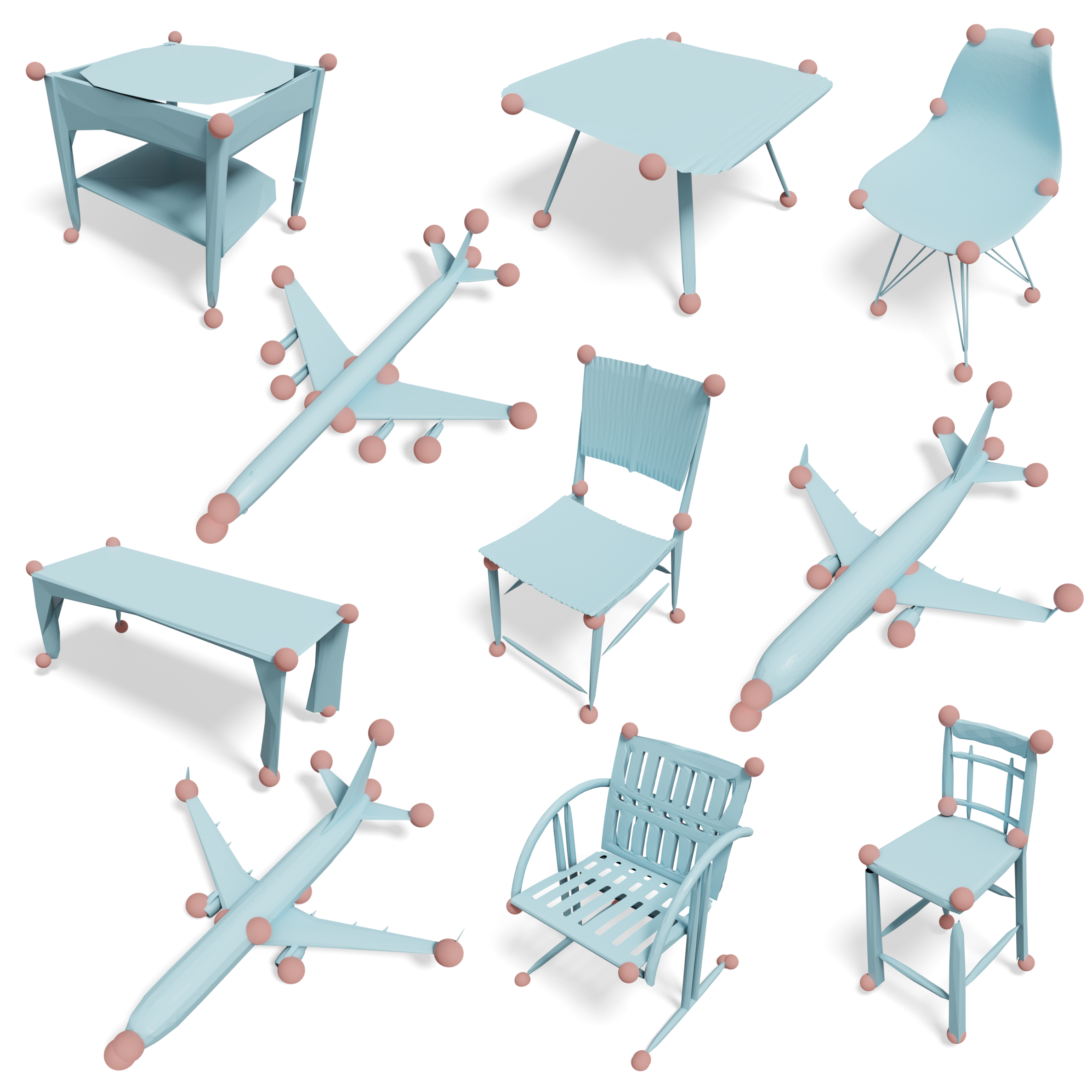
Back to 3D: Few-Shot 3D Keypoint Detection with Back-Projected 2D Features
With the immense growth of dataset sizes and computing resources in recent years, so-called foundation models have become popular in NLP and vision tasks. In this work, we propose to explore foundation models for the task of keypoint detection on 3D shapes. A unique characteristic of keypoint detection is that it requires semantic and geometric awareness while demanding high localization accuracy. To address this problem, we propose, first, to back-project features from large pre-trained 2D vision models onto 3D shapes and employ them for this task. We show that we obtain robust 3D features that contain rich semantic information and analyze multiple candidate features stemming from different 2D foundation models. Second, we employ a keypoint candidate optimization module which aims to match the average observed distribution of keypoints on the shape and is guided by the back-projected features. The resulting approach achieves a new state of the art for few-shot keypoint detection on the KeyPointNet dataset, almost doubling the performance of the previous best methods.
BibTeX@inproceedings{wimmer2023back, title = {Back to 3D: Few-Shot 3D Keypoint Detection with Back-Projected 2D Features}, author = {Wimmer, Thomas and Wonka, Peter and Ovsjanikov, Maks}, booktitle = {Proceedings of the IEEE/CVF Conference on Computer Vision and Pattern Recognition ({CVPR})}, year = {2024}, } -
 ISMRM 2024
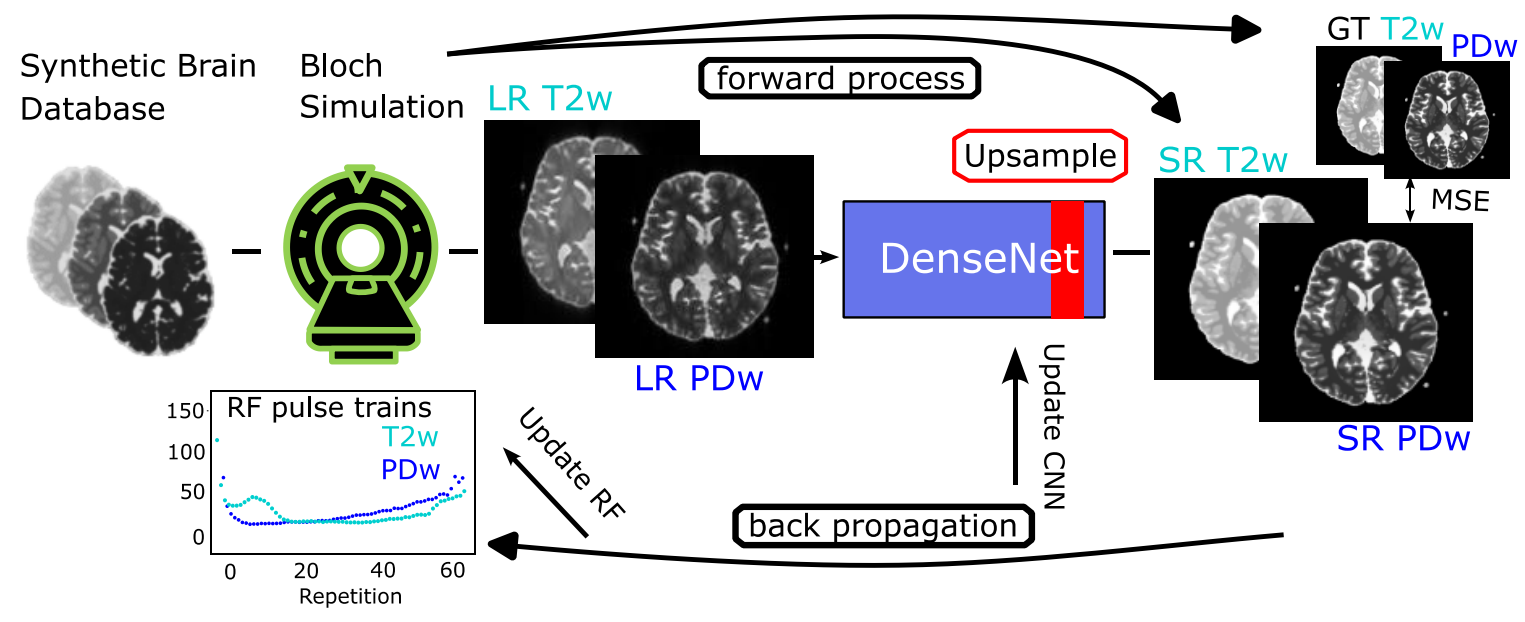
Joint MR sequence optimization beats pure neural network approaches for spin-echo MRI super-resolution
Current MRI super-resolution (SR) methods only use existing contrasts acquired from typical clinical sequences as input for the neural network (NN). In turbo spin echo sequences (TSE) the sequence parameters can have a strong influence on the actual resolution of the acquired image and have consequently a considera-ble impact on the performance of the NN. We propose a known-operator learning approach to perform an end-to-end optimization of MR sequence and neural net-work parameters for SR-TSE. This MR-physics-informed training procedure jointly optimizes the radiofrequency pulse train of a proton density- (PD-) and T2-weighted TSE and a subsequently applied convolutional neural network to predict the corresponding PDw and T2w super-resolution TSE images. The found radiofrequency pulse train designs generate an optimal signal for the NN to perform the SR task. Our method generalizes from the simulation-based optimi-zation to in vivo measurements and the acquired physics-informed SR images show higher correlation with a time-consuming segmented high-resolution TSE sequence compared to a pure network training approach.
BibTeX@inproceedings{dang2024joint, title = {Joint MR sequence optimization beats pure neural network approaches for spin-echo MRI super-resolution}, author = {Dang, Hoai Nam and Golkov, Vladimir and Wimmer, Thomas and Cremers, Daniel and Maier, Andreas and Zaiss, Moritz}, booktitle = {International Society for Magnetic Resonance in Medicine ({ISMRM}) Annual Meeting}, year = {2024}, } -
 Findings of ACL 2023
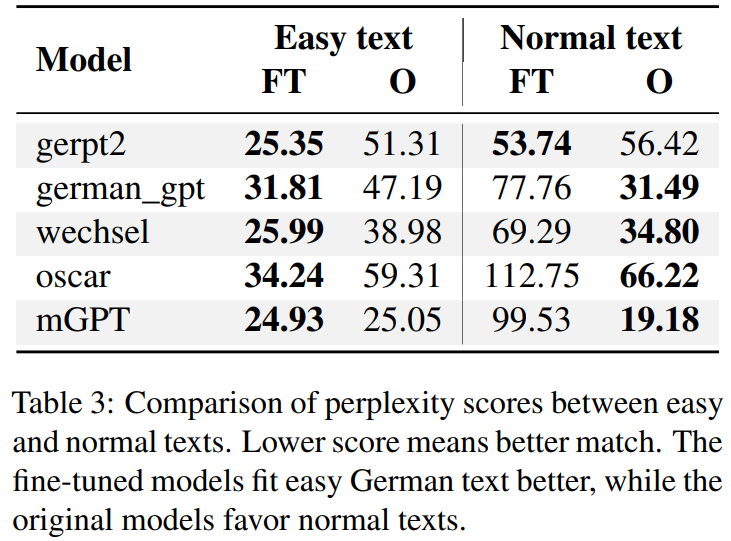
Language Models for German Text Simplification: Overcoming Parallel Data Scarcity through Style-specific Pre-training
Automatic text simplification systems help to reduce textual information barriers on the internet. However, for languages other than English, only few parallel data to train these systems exists. We propose a two-step approach to overcome this data scarcity issue. First, we fine-tuned language models on a corpus of German Easy Language, a specific style of German. Then, we used these models as decoders in a sequence-to-sequence simplification task. We show that the language models adapt to the style characteristics of Easy Language and output more accessible texts. Moreover, with the style-specific pre-training, we reduced the number of trainable parameters in text simplification models. Hence, less parallel data is sufficient for training. Our results indicate that pre-training on unaligned data can reduce the required parallel data while improving the performance on downstream tasks.
BibTeX@inproceedings{anschutz-etal-2023-language, title = {Language Models for {G}erman Text Simplification: Overcoming Parallel Data Scarcity through Style-specific Pre-training}, author = {Ansch{\"u}tz, Miriam and Oehms, Joshua and Wimmer, Thomas and Jezierski, Bart{\l}omiej and Groh, Georg}, booktitle = {Findings of the Association for Computational Linguistics: ACL 2023}, year = {2023}, address = {Toronto, Canada}, publisher = {Association for Computational Linguistics}, url = {https://aclanthology.org/2023.findings-acl.74}, pages = {1147--1158}, } -
 arXiv Preprint 2023
Scale-Equivariant Deep Learning for 3D Data
The ability of convolutional neural networks (CNNs) to recognize objects regardless of their position in the image is due to the translation-equivariance of the convolutional operation. Group-equivariant CNNs transfer this equivariance to other transformations of the input. Dealing appropriately with objects and object parts of different scale is challenging, and scale can vary for multiple reasons such as the underlying object size or the resolution of the imaging modality. In this paper, we propose a scale-equivariant convolutional network layer for three-dimensional data that guarantees scale-equivariance in 3D CNNs. Scale-equivariance lifts the burden of having to learn each possible scale separately, allowing the neural network to focus on higher-level learning goals, which leads to better results and better data-efficiency. We provide an overview of the theoretical foundations and scientific work on scale-equivariant neural networks in the two-dimensional domain. We then transfer the concepts from 2D to the three-dimensional space and create a scale-equivariant convolutional layer for 3D data. Using the proposed scale-equivariant layer, we create a scale-equivariant U-Net for medical image segmentation and compare it with a non-scale-equivariant baseline method. Our experiments demonstrate the effectiveness of the proposed method in achieving scale-equivariance for 3D medical image analysis.
BibTeX@article{wimmer2023scale, title = {Scale-Equivariant Deep Learning for 3D Data}, author = {Wimmer, Thomas and Golkov, Vladimir and Dang, Hoai Nam and Zaiss, Moritz and Maier, Andreas and Cremers, Daniel}, journal = {arXiv preprint}, year = {2023}, } -
 IJCSS 2025 Young Researcher Award
Which Indicators Matter? Using Performance Indicators to Predict In-Game Success-Related Events in Association Football
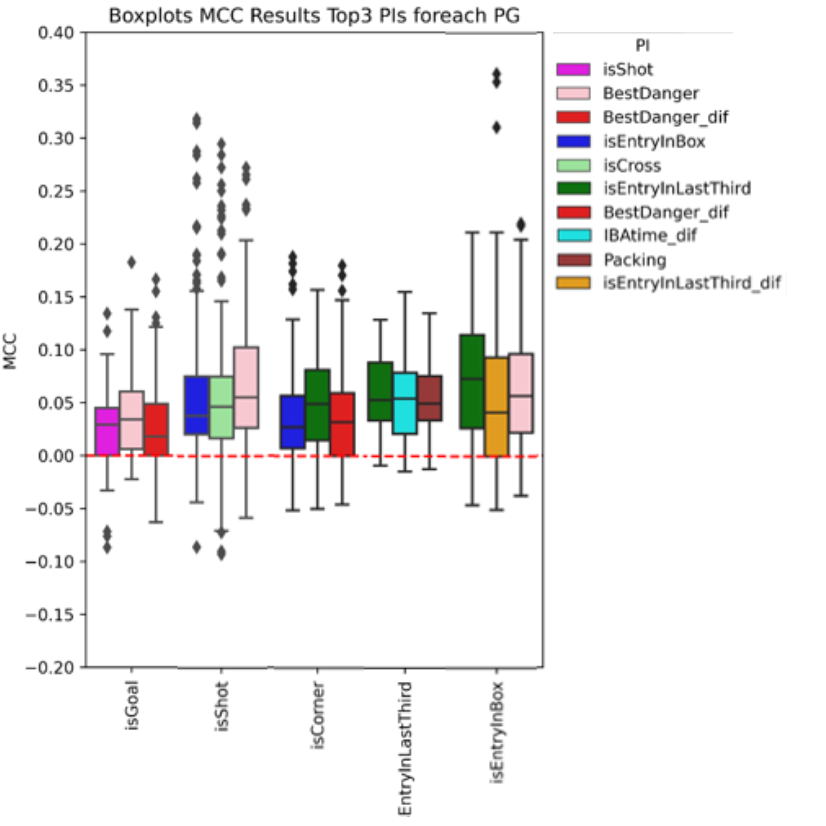
First presented in 2023. Published 2025 in IJCSS. Young Researcher Award at 28. Annual Conference of the Commission on Soccer of the German Association for Sports Science (dvs), 2023.This study evaluates the predictive power of common performance indicators (PIs) in soccer for success- or scoring-related events (SREs) such as shots, corner kicks, and box entries. Using data from 102 Bundesliga matches, we applied five machine learning methods to assess how well 28 widely used PIs (e.g., passes, ball possession time, opponents outplayed) within a past time span (up to 15 minutes) predict an SRE in a future window (up to 15 minutes). We ranked PIs based on the mean Matthews Correlation Coefficient. Results show PIDangerousity best predicts SREGoal and SREShotTaken, while PIEntriesAttaThird is strongest for SRECornerkick, SREEntryAttaThird, and SREEntryOppBox. PIDangerousity and PISuccPassAttThird consistently rank in the Top 9, highlighting their predictive strength. Combining PIOutplayedOpp and PITacklingsWon over a five-minute input window improves goal prediction within three minutes, outperforming random guessing by 6%. PIs based on rare events, such as goals and corner kicks, are less effective for SRE prediction, whereas those capturing frequent actions (e.g., final-third possession, Dangerousity, outplayed opponents) perform better. These findings highlight the value of in-game data for short-term event prediction and its potential applications in quantifying match momentum, optimizing live betting odds, and improving performance analysis.
BibTeX@inproceedings{lang2023vorhersage, title = {Which Indicators Matter? Using Performance Indicators to Predict In-Game Success-Related Events in Association Football}, author = {Lang, Steffen and Wimmer, Thomas and Isenko, Alexander and Link, Daniel}, booktitle = {Issue 2/2025 of the International Journal of Computer Science in Sport}, publisher = {International Journal of Computer Science in Sport}, year = {2023}, note = {First presented in 2023. Published 2025 in IJCSS. Young Researcher Award at 28. Annual Conference of the Commission on Soccer of the German Association for Sports Science (dvs), 2023.}, }